Phantom lets you burn eligible unverified NFTs on Solana and reclaim their account storage balance
Phantom lets you permanently burn eligible unverified NFTs on Solana and reclaim SOL held in their token accounts. The built-in Burn Token control removes the selected collectible through a blockchain transaction. Hiding an NFT only changes its visibility. Review the item before confirming, because a successful burn cannot be undone.
Unexpected collectibles often contain links that promise prizes or rewards. Those links can lead to phishing sites. Use the wallet’s own controls for cleanup, and distinguish the storage refund from the network fee that the transaction requires.
Hiding an NFT preserves its ownership, while burning an eligible Solana collectible permanently removes it and releases refundable account storage funds.
Open the collectible’s burn control or leave it hidden
The Collectibles area contains the item’s More menu, with Burn Token appearing when the wallet permits burning. That option opens a confirmation screen with a final Burn button. If it isn’t present, hiding or reporting the item is the available cleanup option.
The mobile app and browser extension both place this action in the selected collectible’s menu. Inspect the exact item that the confirmation names, including its network. When an unsolicited collectible copies familiar artwork or a collection name and includes a reward claim, the appearance of its details in the wallet doesn’t establish that either the NFT or the linked site is genuine. You don’t need to follow that description’s instructions to access the wallet’s own controls.
Reporting spam hides the item and contributes to filtering; neither reports nor visibility toggles destroy the token.
Check the item and the signing account
Burning through the wallet requires signing authority for the selected collectible and enough spendable SOL to pay the transaction fee. Confirm the selected account, the Solana network, and the exact item before approving destruction. Here, an unverified collection lacks Magic Eden verification; that classification alone doesn’t prove fraud. The wallet blocks burning for collectibles verified by Magic Eden. An item that you want to keep shouldn’t become a burn candidate solely because its collection hasn’t received that verification. Stop if the transaction preview raises a security warning.
Where does the returned SOL come from?
The returned SOL comes from account storage funding, often called rent, rather than payment for the NFT. Solana stores conventional token balances in token accounts that hold SOL to cover their storage requirement. That funding is separate from the collectible’s purchase price and any value that a marketplace might assign to it.
Closing a Solana token account transfers its stored SOL to the destination specified by the close instruction. For a conventional token-based NFT, the token balance must reach zero before its account can close. Burning a token and closing its empty account serve different purposes, even when a wallet combines instructions in a single transaction.
Account size influences the minimum storage balance, and the actual accounts that close determine the amount that returns. A remembered per-NFT rebate won’t necessarily describe the selected item. Different NFT account structures can involve different storage deposits, so the balance in an eligible account determines the refund.
Solana also charges a network fee to process the transaction. That fee has a base component and may include a priority component. The fee payer must cover it before execution, so SOL held in an NFT account can’t automatically fund that same transaction. Review the fee that the wallet presents before confirming.
For the same fee-paying wallet, with no other balance movements, the net change equals the SOL returned minus the transaction fee. A token swap doesn’t create this refund: account closure releases SOL that was already there. Any additional charges or transfers in the transaction also affect the final wallet balance.
A hypothetical cleanup that ends in permanent removal
In this hypothetical example, a reader wants to remove an unwanted, unverified NFT permanently. The selected Solana account holds the item, the reader has identified it as safe to handle, the built-in burn control is available, and there’s enough spendable SOL for the fee. Hiding would leave the token onchain, so burning fits that intention.
The reader opens the collectible, chooses More, then Burn Token, reviews the confirmation, and selects Burn.
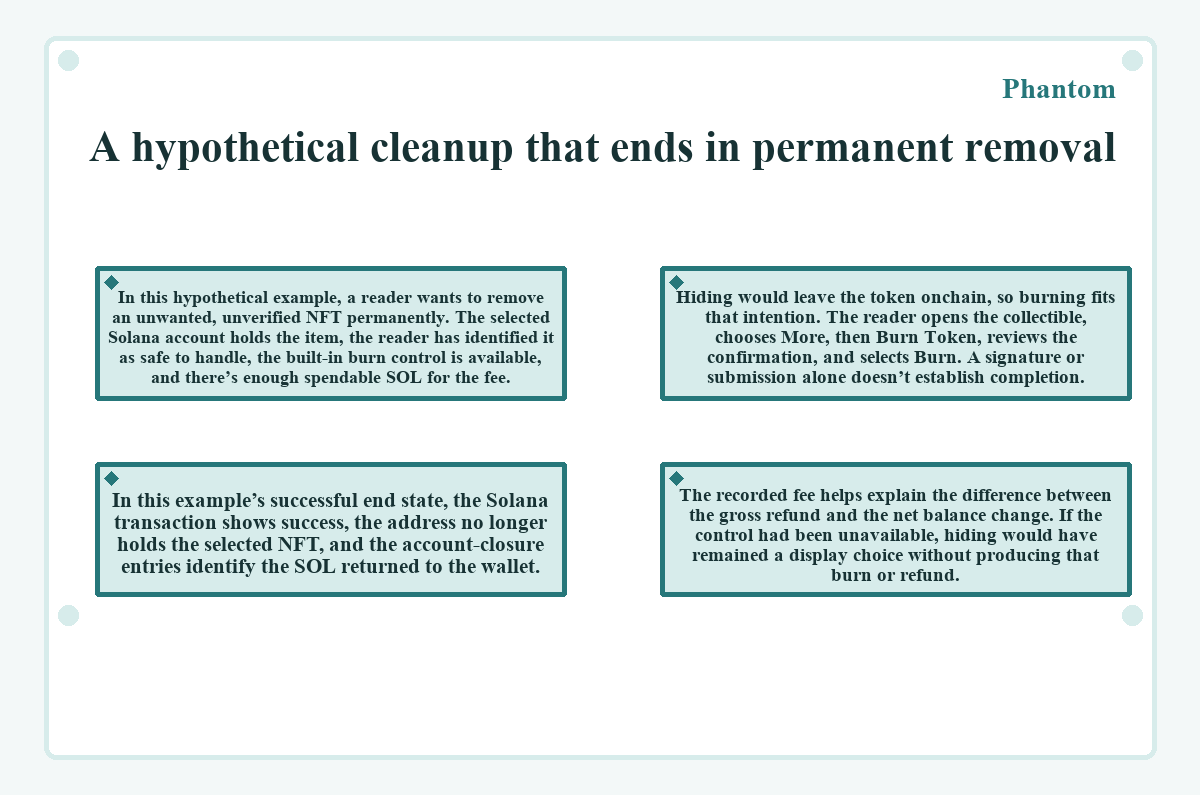
A signature or submission alone doesn’t establish completion. In this example’s successful end state, the Solana transaction shows success, the address no longer holds the selected NFT, and the account-closure entries identify the SOL returned to the wallet. The recorded fee helps explain the difference between the gross refund and the net balance change. If the control had been unavailable, hiding would have remained a display choice without producing that burn or refund.
What does burning change on the blockchain?
Burning a conventional token-based NFT reduces its token account balance and mint supply, while account closure releases the refundable storage balance. Phantom cannot reverse a completed NFT burn. Closing an NFT’s token account doesn’t delete the entire wallet or close unrelated token accounts. A recovery phrase can restore wallet access; it can’t restore a burned asset.
Unavailable controls and transactions that don’t complete
An absent Burn Token action isn’t an invitation to try a link embedded in the NFT. The built-in feature covers eligible Solana collectibles and doesn’t provide burning for NFTs on Ethereum Virtual Machine networks. Marketplace verification can also disable the action. Other asset programs have their own burn rules.
An unsubmitted or rejected request hasn’t produced a burn. Solana processes the instructions within a transaction together. If an instruction fails, the transaction’s state changes revert, although the fee can still be charged. A pending entry hasn’t yet established completion, so check an existing attempt’s status before retrying, especially when the wallet has created a transaction identifier but hasn’t shown that the transaction succeeded.
Leave the NFT hidden when unavailable controls or a security warning prevent you from completing the burn.
Practical questions
Who receives the SOL when I burn an NFT that somebody else sent me?
Phantom’s built-in burn returns the eligible account balance to your wallet. At the program level, the token account’s owner or close authority authorizes its closure and the destination that receives its stored SOL. The person who originally paid to create that account doesn’t automatically receive its balance when it closes.
Can an unsolicited NFT give its sender control of my wallet?
Receiving an NFT doesn’t grant its sender signing authority over your wallet. The danger often comes from a link in its description that leads to a malicious site or transaction request. An unexpected collectible can stay hidden without your connecting to that site or approving a claim.
Will burning delete the NFT’s image from every website?
Burning doesn’t delete every external copy of an NFT’s image. Many Solana NFTs reference off-chain files for their artwork and descriptions. Destroying the token or closing its onchain accounts doesn’t remove those external files or copies that somebody else has saved.
Why is the Collectibles section missing on mobile when I want to burn an NFT?
The mobile app may omit Collectibles when it can’t confirm that any held collections are verified. This display state doesn’t establish that an NFT has been burned. After confirming the holding onchain, the browser extension can help surface collectibles that mobile doesn’t show; pinning an item there and reopening mobile can restore the section.
Does reporting NFT spam block future airdrops to my address?
Reporting changes spam filtering; it doesn’t close your Solana address to incoming assets. For ordinary Solana tokens, the source account’s owner or approved delegate can authorize a transfer without the receiving wallet connecting to a website. A report can help hide spam, but new unsolicited items may still reach the same address.
What prevents an owner from burning a locked Token Metadata NFT?
A delegated lock can prevent the owner from burning a Token Metadata NFT until the asset is unlocked. Some locks also prevent the owner from revoking the locking delegate while the lock remains active. These are asset-program restrictions, and a wallet menu can’t bypass them.
Are earlier token approvals removed when I burn an NFT?
Burning an NFT doesn’t revoke spending permissions that an app holds over other assets. Those permissions need separate attention if you previously approved a suspicious transaction. Disconnecting an app also doesn’t revoke existing token approvals.
Do I need to disclose my recovery phrase to burn an NFT?
You don’t need to disclose your recovery phrase to use the wallet’s built-in burn control. The action requires authorization within the wallet, not a phrase submitted to an NFT website or somebody offering cleanup assistance. Sharing the phrase gives its recipient control of the wallet.