Phantom recovery: wallet credentials and account access
Phantom recovery can restore access when you still have the credentials for the original wallet. A recovery phrase can restore its derived accounts, and Google or Apple sign-in restores wallets created that way, with a PIN if prompted. The browser extension password only unlocks the existing installation. Separately imported accounts need their own backups, while hardware accounts need their device connection. If you still have full wallet access on a device, preserve your backups before resetting or reinstalling the app.
Bottom line: A saved recovery phrase covers the accounts derived from it, so separately imported wallets need their own credentials before any reset.
Match the recovery method to the missing account
Use the backup that controls the missing account, including a separate phrase or private key for an imported wallet.
An account derived from a recovery phrase belongs to that phrase’s backup. A wallet created through Google or Apple has its original sign-in route and an exportable phrase. An imported private key controls its particular address, while a connected hardware wallet keeps its credentials outside Phantom. Several account types can appear in the same installation. Account names don’t establish which backup controls an address. An account used for swaps retains the recovery requirements of the credentials behind it.
If you still have full wallet access, export missing backups before removing its local data. Otherwise, you’ll need saved credentials or the original sign-in account and its PIN, if required.
Can my browser password restore access?
No, your browser extension password unlocks the existing installation; restoring access after a reset requires the original wallet credentials. It doesn’t substitute for a recovery phrase or the appropriate Google or Apple sign-in. If you’ve forgotten it, Phantom’s password reset wipes local app data before restoration and creation of a new password. Collect backups for every separately imported wallet before using that reset. Mobile biometrics likewise unlock the current device without replacing the wallet’s recovery method.
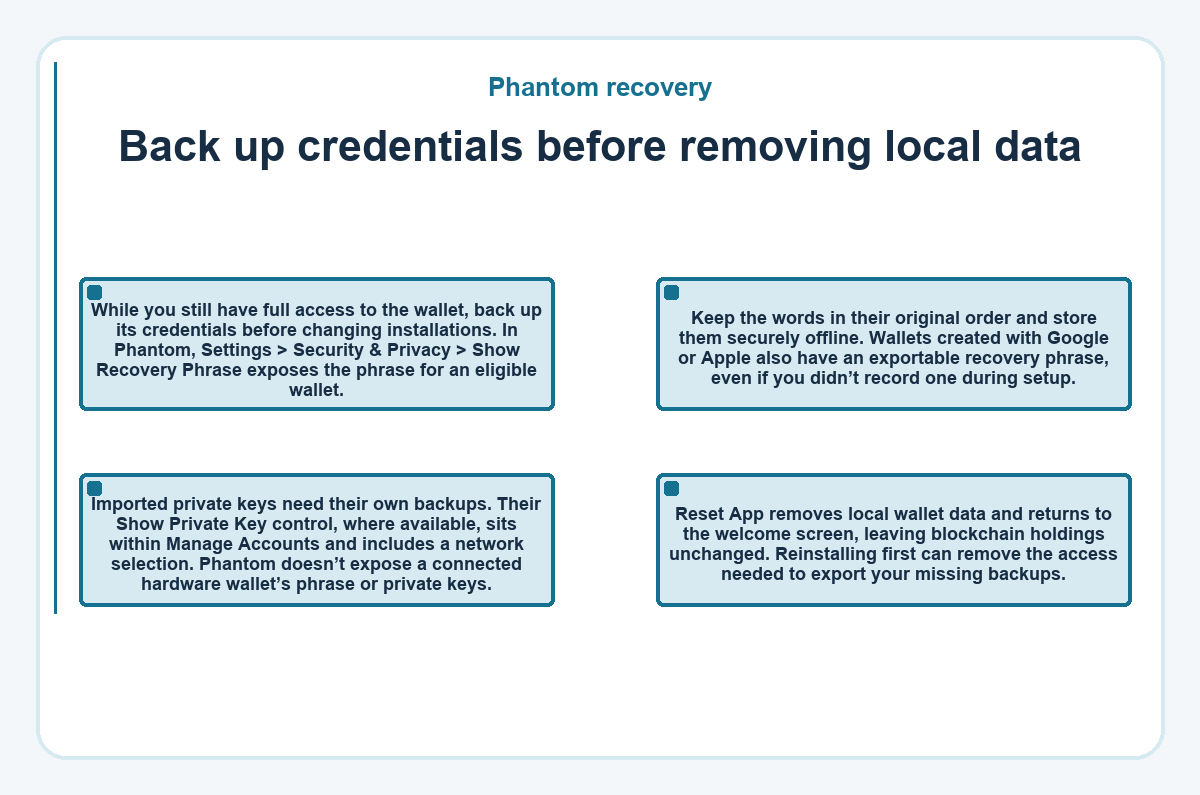
Back up credentials before removing local data
While you still have full access to the wallet, back up its credentials before changing installations. In Phantom, Settings > Security & Privacy > Show Recovery Phrase exposes the phrase for an eligible wallet. Keep the words in their original order and store them securely offline. Wallets created with Google or Apple also have an exportable recovery phrase, even if you didn’t record one during setup. Imported private keys need their own backups. Their Show Private Key control, where available, sits within Manage Accounts and includes a network selection.
Phantom doesn’t expose a connected hardware wallet’s phrase or private keys. Reset App removes local wallet data and returns to the welcome screen, leaving blockchain holdings unchanged. Reinstalling first can remove the access needed to export your missing backups.
Google and Apple sign-in before and after PIN migration
The original Google or Apple account remains the starting point for a wallet created through sign-in. Use the same provider and account. Matching email text across different providers doesn’t identify the same wallet: Google and Apple sign-ins can lead to separate wallets.
PIN requirements
Wallets that still request a PIN
Some wallets retain the earlier four-digit PIN requirement. Their restoration uses the original sign-in account together with that PIN. If you’re still signed in and need to change it, Settings > Security & Privacy > Reset PIN provides the control. Its absence indicates that the wallet doesn’t use a PIN.
Wallets upgraded to sign in without a PIN
After a sign-in wallet completes its migration to Phantom’s Key Management System (KMS), restoration no longer requires the separate PIN. The connected Google or Apple account supplies the sign-in route. Closing or failing the migration confirmation leaves the previous setup unchanged.
Account restoration
Google or Apple sign-in automatically restores the first wallet account. Other accounts under that wallet may need manual addition. This differs from phrase import, which detects previously active accounts. Seeing fewer accounts after sign-in doesn’t itself show that their assets disappeared.
Profile access and wallet addresses
An additional phrase or private key that you enabled as a sign-in method can access the same Phantom profile, Cash account, and predictions. Access to crypto and perpetual positions depends on the wallet addresses linked to that sign-in method. If that method is linked to different wallet addresses, it won’t restore crypto or perpetual positions linked to the original sign-in wallet. Those holdings still require that wallet’s credentials.
Restore a phrase and reconcile the account address
In a hypothetical browser-extension recovery, you have the original phrase and a saved public address from an account derived from it. The phrase must belong to that account, and Phantom must support its derivation path. Importing the phrase restores credentials without transferring assets. Google or Apple sign-in and hardware reconnection use separate controls.
| Recovery stage | Action in the browser extension | What you need beforehand |
|---|---|---|
| Preserve backups | Keep the original phrase, separate wallet backups, and the address for comparison. | Complete credentials for every wallet affected by a reset. |
| Open restoration | From the welcome screen, choose I Already Have a Wallet, then Import Recovery Phrase. | If the extension needs resetting, secure its backups before wiping it. |
| Import the phrase | Enter the words in order, then select Import Wallet. | A correctly formatted phrase and compatible account derivation. |
| Set local protection | Create a password for this browser installation. | Successful phrase import; the new password protects local access. |
| Reconcile the account | Compare the restored address and its network with the saved address. | The expected address and network from before the loss of access. |
| Restored access | The expected account appears with signing credentials. | A matching address on the intended network. |
The expected state is the original account address, with its existing blockchain history and signing access. The observed address should match your saved record on the same network. An unfamiliar address or an absent account leaves this recovery unresolved, even if Phantom accepted the phrase. A matching account can still show a changed balance if transactions occurred while you lacked access; restoration doesn’t return an earlier balance.
Why are accounts missing after a successful import?
Phantom may omit accounts without onchain activity during phrase import, so an accepted phrase can still leave the account list incomplete. Previously active accounts normally appear automatically. Additional accounts derived from the same phrase can be added through Add Account > Create New Account. If you imported multiple phrases, select the one that originally controlled the missing account.
Phrase validity and account compatibility are separate checks. Phantom accepts BIP-39 recovery phrases containing exactly 12 or 24 words, with correct spelling and word order. Mobile entry uses spaces between words; the extension provides individual word cells. A formatting error prevents import. An accepted phrase that belongs to another wallet can open accounts that you don’t recognize.
Phantom can restore the expected accounts from a correct recovery phrase only if it supports the original wallet’s derivation path. A derivation path determines how the wallet generates account keys from the phrase. If the original app derives accounts differently, continuing with that app may preserve access. An available private key offers another route for its particular address on a supported network. Repeated resets won’t make an incompatible derivation path compatible.
Imported private keys and hardware wallet access
An imported private key doesn’t sync automatically; reimport it on the correct network using its separate backup. Your main phrase doesn’t cover an unrelated private key. For Ledger accounts, reconnect a supported Ledger device on a supported network through Phantom’s hardware controls. If you’ve lost the device, its recovery phrase can restore accounts on a compatible replacement hardware device. Enter that phrase on the replacement device, never into Phantom. Hardware recovery keeps signing keys on the hardware device. Importing the phrase into software would instead expose it to the computer or phone.
Does wallet restoration return stolen funds?
No, restoring credentials restores access to the wallet. It doesn’t reverse completed transfers or retrieve stolen funds.
Your transaction history can show transfers that occurred while you couldn’t open the app. Token balances and collectibles reflect the blockchain state, including changes before restoration. An exposed recovery phrase presents a different problem from a forgotten local password. Anyone holding that phrase can control its derived accounts. Changing the extension password or importing the phrase again doesn’t remove their access. Moving trusted remaining assets to a new wallet changes the keys that control them. Disconnecting an app also doesn’t revoke spending approvals that you previously granted.
Recovery assistance and credential exposure
Phantom Support can help with import and sign-in problems, but it can’t recreate a lost recovery phrase or private key. Sharing either credential lets an unsolicited helper authorize transactions for the accounts that credential controls. Phantom Support doesn’t initiate direct messages or request your phrase. Entering your recovery phrase into a recovery website exposes the same secret that the wallet uses to authorize access.
Keep public troubleshooting information separate from secret credentials. An account address and an error message describe a problem without handing over signing authority. Paying a purported recovery service doesn’t supply a missing backup or give it the ability to reverse a completed blockchain transfer. When no device remains accessible, recovery requires a usable backup or the original supported sign-in route. Technical assistance can resolve an import problem; it cannot replace absent credentials.
Frequently asked questions
Can an iCloud or Google Drive backup restore my Phantom wallet?
An iCloud or Google Drive backup can restore the app, but Phantom doesn’t support using it to restore wallet access. The transferred app may appear watch-only. You’ll still need the original recovery phrase, private key, Google or Apple sign-in credentials (with a PIN if required), or a supported hardware wallet. Separately imported wallets retain their own backup requirements.
What happens after too many incorrect PIN attempts?
For a wallet that uses a PIN, seven incorrect attempts delete the encrypted backup on that device. Recovery then requires another device where you’re still signed in or a recovery phrase that you previously exported.
Why is Show Private Key unavailable for my restored Google or Apple account?
The Show Private Key control isn’t available for Google or Apple accounts powered by Phantom KMS. Those accounts keep signing keys in secure enclaves instead of exposing them through that control. Show Recovery Phrase remains the backup route for the wallet. A missing private-key export button therefore doesn’t establish that restoration failed or that the account has no backup.
Does deleting a wallet affect later recovery through Google or Apple?
Deleting a supported Google or Apple wallet unlinks that account from the Phantom profile. Keep the existing wallet’s recovery phrase before deletion if you want access later. Phantom allows a new wallet with the same sign-in account afterward, so that sign-in shouldn’t be treated as a permanent backup for the deleted wallet. Reset App is a different operation that clears local device data.
Is a public address enough to recover signing access in Phantom?
A public address alone can’t restore signing access to a wallet. It identifies blockchain activity and balances, but deriving its private key from it is practically impossible. Adding an address for observation doesn’t supply the credentials needed to authorize transfers. Recovery still requires the relevant phrase, private key, supported sign-in credentials, or hardware wallet, depending on how that account was created.
Where can I change a known extension password without wiping Phantom?
Settings > Security & Privacy > Change Password lets you change a known browser extension password without resetting the app. The control requires your current password and the replacement password. Your recovery phrase and private keys stay unchanged.